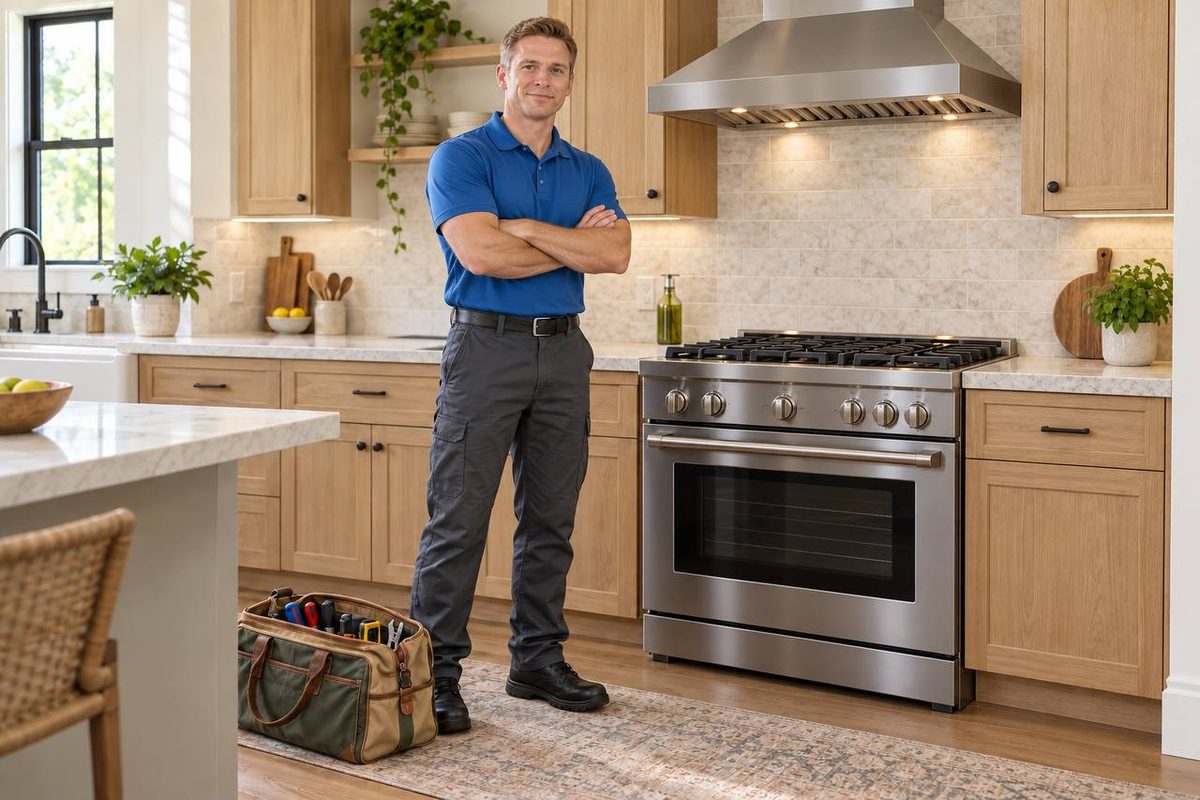
One rule outranks every other step: when a gas smell hangs in the air and does not fade, get everyone outdoors and ring the gas utility from the yard or the street. With that settled, most clicking-but-no-flame complaints turn out to be small problems. Puget Sound Energy pipes natural gas into much of Olympia, Lacey and Tumwater, so gas cooktops show up in plenty of kitchens there, while homes on acreage toward Yelm, Tenino and Rainier tend to cook on propane. Both fail in familiar ways, and most start with a misplaced cap or a wet port.
The gas smell rule, and how long to let it click
Natural gas and propane both carry an added odorant that smells like rotten eggs, so a leak can be noticed early. A faint whiff at the moment a burner lights can be normal. A smell that lingers with the knobs off, grows stronger or fills the kitchen is not. In that case, do not flip light switches, unplug appliances or use a phone inside. Walk everyone out of the house, and only then, standing outdoors, call Puget Sound Energy or whoever fills your propane tank. A suspected leak is the utility's emergency before it is ours, and they will tell you when it is safe to go back in.
Clicking without flame also releases gas, a little at a time. If a burner does not catch within a few seconds, turn the knob off and give the gas several minutes to clear before trying again; your manual lists the exact wait for your model. Long, repeated attempts let gas collect under a pot or around the cooktop, and when it finally catches, the flame can flare. Keep your face and sleeves back while you test. If one burner keeps failing, stop using it and work through the checks below with the knob off and the cooktop cool.
Burner caps that sit off-center
The most common cause we find is also the easiest. A sealed burner has two loose pieces on top, a burner head and a round cap, and both must sit flat and centered. After cleaning, a cap that rests a few millimeters off, tilts on a crumb, or lands on the wrong burner changes how gas leaves the ports. The spark still snaps at the electrode, but gas never reaches it in the right mix, so you hear clicking and see nothing. Many ranges use different cap sizes for the power, simmer and standard burners, and they are easy to swap by accident.
With the burner off and cool, lift the cap and set it back down, then nudge it gently. A properly seated cap sits flat and does not rock. If your model uses a two-piece head, check that it locks onto its base and that the notches or tabs line up. Look at the electrode, the small white post beside the burner; it should be clean, dry and uncracked. Then light the burner again. A healthy flame forms an even blue ring all the way around, and a gap or a lopsided flame means the cap still is not right.
After a boil-over: wet electrodes, crusted ports
Pasta water, oatmeal and tomato sauce do the most damage. A boil-over sends starchy liquid into the burner ports, where it dries into a crust that blocks gas, and it soaks the electrode so the spark tracks to wet metal instead of jumping to the cap. The result is weak, scattered clicking and no flame, or a burner that lights on one side only. With humidity hovering near 80 percent and fall fog settling in for days, a wet burner can take a surprisingly long time to dry on its own, especially in a cool kitchen overnight.
Unplug the range or switch off its breaker, then let the burner cool fully. Lift off the cap and head and wash them in warm, soapy water. Clear each port with a straightened paper clip or a sewing needle, working straight in; avoid toothpicks, which snap off and stay put. Wipe the electrode with a dry cloth, and do not spray cleaner around the knobs or into the burner opening, because liquid that runs down into the spark switches causes the next problem. Let every piece dry completely, ideally for several hours, before reassembling the burner.
Where our crew works
Tap a town on the map to open its page. Our crew covers Olympia, Lacey, Tumwater, Yelm, Tenino and Rainier.
Clicking that won't stop: spark switches and module
On most ranges, turning any burner knob makes every electrode spark at once. That is normal: one spark module feeds them all, and a switch behind each knob tells the module when to fire. Clicking that continues after the knob is off is different. It usually means a spark switch is stuck closed, often because liquid from a boil-over or a soaked sponge ran down the valve stem and into the switch. Cut power to the range at its breaker and let it sit for several hours or overnight. If the clicking stops as the switch dries, watch for repeats, which mean the switch is failing.
If clicking returns with dry switches, or starts without a spill, the switch itself or the spark module is suspect. Surges and quick on-off cycles after power outages can damage modules, and fall and winter windstorms bring plenty of those to Thurston County. Spark switches sit on the valve manifold behind the control panel, with live wiring beside the gas valves, so replacing them is technician work. On models with automatic reignition, a burner that clicks even while lit is often a cap or port problem in disguise: the flame never touches the electrode, so the range thinks it is out.
One burner silent, or none: electrodes, wiring, power
If the other burners spark but one stays quiet, the fault is local to that burner. In a dim kitchen, turn the knob and watch the electrode. A healthy spark is a sharp blue snap jumping from the tip to the cap. A spark that appears lower, near the base of the electrode, means the porcelain is cracked and the current is shorting to ground. No spark at all suggests a broken electrode wire, a loose terminal or a failed switch for that knob. Electrodes and their leads are routine replacements for our technicians.
If no burner clicks at all, check power first. Gas ranges plug into a standard outlet for the spark, the clock and the oven controls, and a tripped breaker, a plug nudged loose during cleaning, or a power outage leaves everything silent. During an outage, many manuals allow lighting the surface burners carefully with a long match; check yours first, and never try to light a gas oven by hand. When the power returns, a range that still will not spark may have a module or control problem worth testing, above all after a surge.
Propane conversions on rural ranges
Nearly every new gas range arrives configured for natural gas. On propane, which rural homes around Yelm, Tenino, Rainier and the Littlerock Road corridor depend on, the range needs a conversion: smaller orifices at each burner, the pressure regulator switched to propane, and the low-flame screw on each valve adjusted. A range that came from a city kitchen on PSE gas and never got converted burns tall, yellow and sooty. A partial conversion causes subtler trouble, such as a simmer burner that sparks on its lowest setting without ever lighting, or one that snuffs out when a pot lands on the grate.
Conversion parts and pressure settings are gas work for our technicians or your propane supplier. On the phone, let us know which fuel feeds the range, utility gas or a propane tank, and what the clicking sounds like. We work in Rainier, Tenino, Yelm, Tumwater, Lacey and Olympia, and same-day visits are possible when our calendar has an opening. Pinning down the cause costs $97. Green-light the work and every cent of it counts toward the bill; turn the repair down and that $97 is the only thing you pay. You get one fixed, written quote first. Spark switches and electrodes usually come with us on the van, and a maker's warranty should be your first call.
Care tip: After any boil-over, wipe the burner and electrode dry before the next use, and wash caps at the sink instead of spraying cleaner across the cooktop. Before lighting, give each cap a gentle nudge to make sure it sits flat. Dry, centered caps prevent most of the clicking we get called about.
Questions we get about this
Why do all four burners click when I only turn on one?
On most gas ranges, a single spark module serves every burner, so turning any knob makes all the electrodes spark together. Only the burner with gas flowing lights. Once the flame catches and you turn the knob away from the light position, the clicking should stop. If it continues after the burner is lit, or after the knob is off, a spark switch or the module needs attention.
Our Rainier range was converted to propane, but the simmer burner keeps going out. Is that the conversion?
It may be. A full propane conversion includes setting the low-flame screw on each burner valve, and if it was missed, the lowest settings run too small to stay lit, especially when a pot or a draft disturbs the flame. Ports half blocked by a boil-over cause the same symptom, so clean that burner first. If it still fails, have a technician check the valve settings.
After washing the cooktop in Olympia, the range keeps clicking with every knob off. What should I do?
Moisture has almost certainly reached a spark switch behind one of the knobs. Switch the range off at its breaker or unplug it, pull the knobs off if they come away easily so air can reach the stems, and leave everything to dry for several hours or overnight. Often the clicking stops for good. If it returns once the range is fully dry, the switch is failing and should be replaced.
Burner still clicking? Have our crew check it
From city kitchens on PSE gas to propane ranges on rural acreage, our crew tests the spark, the switches and the flame before quoting. You approve one fixed written quote before anything changes.