Gas, Propane, Electric and Induction Cooking Repair
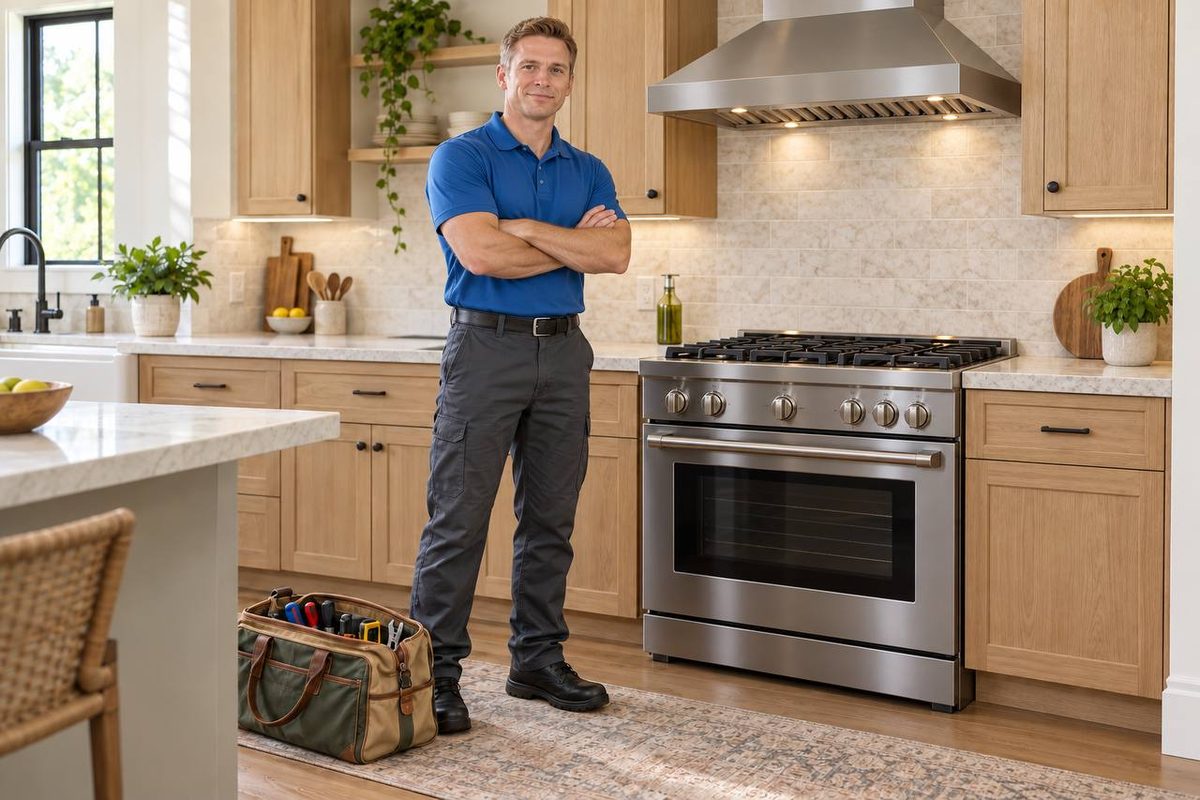
An oven that won’t heat tends to fail on the day it matters most, with a roast waiting or a pan of rolls ready to go in. Our technicians repair freestanding and slide-in ranges, wall ovens and cooktops across Olympia, Lacey, Tumwater, Yelm, Tenino and Rainier. Natural gas lines reach a large number of houses in the three core cities, so you will find gas ranges in kitchens from Southeast Olympia to Tumwater Hill, while the rural acreage around Yelm, Tenino and Rainier tends to cook on propane. Apartments and older rentals lean on electric coil and smooth glass tops, induction cooktops show up in newer remodels, and double wall ovens anchor many custom kitchens. Whatever fuel or style your kitchen uses, our crew carries the parts and service information to work on it.
Cooking appliances fail in a few predictable ways, and our crew confirms which one before quoting. With a gas oven, we clock the igniter’s glow and put an ammeter on it; a glowing igniter is not proof of a healthy one, since the safety valve needs a certain amperage before it lets gas through. With an electric oven, we meter the upper and lower coils and look them over for blisters or breaks. On both, we test the oven temperature sensor and read any fault codes stored in the control. Surface burners get their own checks: spark electrodes and the spark module on gas tops, infinite switches and receptacles on coil tops, and elements and limiters under radiant glass. Before we call any temperature repair finished, we run the oven and compare a thermocouple reading against the set temperature.
Spark electrodes, igniters, oven sensors, infinite switches, door gaskets and both bake and broil elements travel on our vans, so many oven and range repairs finish on the first visit. Once we know the cause, you get one fixed quote in writing, and no part is swapped before you sign off on it. Say yes and every dollar of the $97 diagnostic is applied to that repair; say no and the bill for the visit stays at $97. Control boards, glass cooktop panels and some gas valves are ordered by model, and when that happens we schedule a return visit to install the part without another trip charge. For wall ovens, we tell you ahead of time if the unit needs to come out of the cabinet, so the area around it can be cleared.
Oven, Range and Cooktop Problems We Repair
- Gas oven cold, burners still work. When the cooktop lights but the gas oven is not heating, the hot-surface igniter is the usual cause. An aging igniter keeps glowing, yet its current draw slips below what the safety valve needs, and the valve stays shut with the burner dry. We measure the igniter’s current draw, check voltage at the safety valve, and confirm the bake and broil burners light and hold a steady flame before we finish.
- Electric oven stays cool or uneven. An electric oven that heats only from the top, or barely heats at all, usually has a failed bake element. Some burn through with a visible blister or break, while hidden elements under the oven floor fail out of sight. We read each element’s resistance and the voltage arriving at its terminals, then inspect the wiring and terminal block behind the rear panel for heat damage.
- Temperature runs hot or cold. Cakes that brown on the outside before the center sets, or roasts that take far longer than the recipe says, point to a temperature problem. A drifting oven sensor, a door gasket that leaks heat, sagging hinges, or a weak igniter that slows heat recovery can each cause it. We check the sensor’s resistance, inspect the door seal and hinges, and verify the oven with a thermocouple.
- Surface burner sparks, no flame. Endless ticking with no flame, or ticking that continues once lit, usually traces to moisture or food crust on the spark electrode, cracked ceramic on it, a cap slid off center, or ports plugged with residue. A spark switch soaked by a boil-over can make every burner click at once. We clean and dry the burner parts, check that each cap sits flat, test the spark module and inspect the switch wiring.
- Electric or induction zone not working. On coil cooktops, a dead burner comes down to three suspects (the coil itself, its socket, or the knob’s infinite switch), and trading two coils between positions quickly narrows it. Radiant glass tops hide the same parts under the glass. Induction zones need a pan that a magnet sticks to; if the pan passes and the zone still shows an error, we check the cooling fan, the coil connections and the power boards.
- Door stays locked after self-clean. If the oven door will not unlock after a self-clean cycle, the oven may still be too hot, so give it time to cool completely first. When it stays locked once cool, the door lock motor, its switch, or the sensor that tells the control the cavity is safe has usually failed. The cycle’s extreme heat also stresses thermal fuses. We test the whole lock circuit before replacing parts.
Range and Oven Parts We Carry and Test
- Oven igniter. In most gas ovens, a hot-surface igniter glows and draws current through the safety valve to open it. Age weakens it gradually, so the oven takes longer to light and eventually never lights at all. We measure its amperage while it glows and replace it once it falls below what the valve needs.
- Bake and broil elements. These heavy coiled elements heat an electric oven from below and above. A burned-through spot, a blister or a short to the outer sheath leaves the oven cold or trips a breaker. We check resistance and insulation with a meter and inspect the terminals and wires behind the rear panel for scorching.
- Oven temperature sensor. This thin probe inside the oven cavity tells the control how hot the oven is. When its resistance drifts, the oven runs hot or cold, or the control shows a fault code. We read the sensor’s resistance with the oven cold, check its harness, and confirm the oven settles where it is set.
- Spark electrode and module. Each gas burner has a small ceramic electrode that sparks to light it, fed by a spark module behind the controls. Cracked ceramic, wet switches and a weak module are common culprits. We watch the spark at every burner, meter the switches, and swap whichever electrode or module has failed.
- Infinite switch. The knob on a coil or radiant electric cooktop turns an infinite switch, which cycles the burner on and off to set the heat level. Its contacts wear, and the burner sticks on high or never heats. We meter the switch, check the wiring for heat damage, and fit the correct replacement.
Where our crew works
Oven & Range Repair across the South Sound, with same-day slots when the schedule allows. Tap a town for its page.
Fuel, Power and Older Wiring in Our Six Towns
Water barely touches most ovens, so for cooking appliances the local story is fuel and power. Puget Sound Energy supplies natural gas to parts of the county, and the share of homes heated with it in Olympia, Lacey and Tumwater falls in a 35 to 44 percent band, so gas ranges are common there. Rural kitchens near Yelm, Tenino and Rainier often cook on propane instead. Olympia’s housing skews older, close to half of it predating 1980; of every nine houses, one was already standing before 1940. In kitchens that old, any weak-heat electric call includes a look at the 240-volt receptacle and terminal block. After windstorm outages, electronic controls can lose their settings or show fault codes, and the surge when power returns sometimes damages a control board.
Range and Oven Brands We Service
A range or wall oven still inside its manufacturer’s warranty should go to the maker first, and we will say so before scheduling. Beyond it, our technicians repair GE, GE Profile and Café ranges and wall ovens; Whirlpool, KitchenAid, Maytag and Amana, which share many igniters, elements and sensors; Frigidaire and Electrolux; LG and Samsung ranges, including slide-in and induction models; Bosch cooktops and wall ovens; and the many Kenmore ranges still cooking in older homes. Gas and propane burners, electric coils, radiant glass and induction are all part of our regular work. On a freestanding range, the model tag is usually behind the storage drawer or on the oven frame with the door open, and a photo helps.
When an Oven or Range Is Worth Repairing
Igniters, elements, sensors, spark electrodes, infinite switches, door gaskets and hinges are routine repairs, and they make sense on almost any range with a sound body and working controls. The harder calls: an older range whose glass top has cracked, a dead electronic control on an entry-level range that is also rusting or sagging at the hinges, or a gas valve problem on top of other wear. Wall ovens and built-in cooktops lean strongly toward repair, because a replacement has to match the cabinet cutout or countertop opening exactly. Age alone is a poor guide, since a simple older range with a fresh igniter can cook reliably for years. We give you the readings and the written quote, and you decide.
Care tip: On an oven more than about ten years old, skip the self-clean cycle. Its extreme heat stresses the door lock, the thermal fuse and the temperature sensor, and holiday baking is when those parts tend to give out. Instead, wipe up spills once the oven has cooled, and use a baking soda paste on stubborn spots.
Service by town
Repair guides
Book oven & range repair
One fixed quote after diagnosis. $97 diagnostic, applied to the repair if you go ahead.