Dishwasher Service From Downtown Olympia to the County Roads
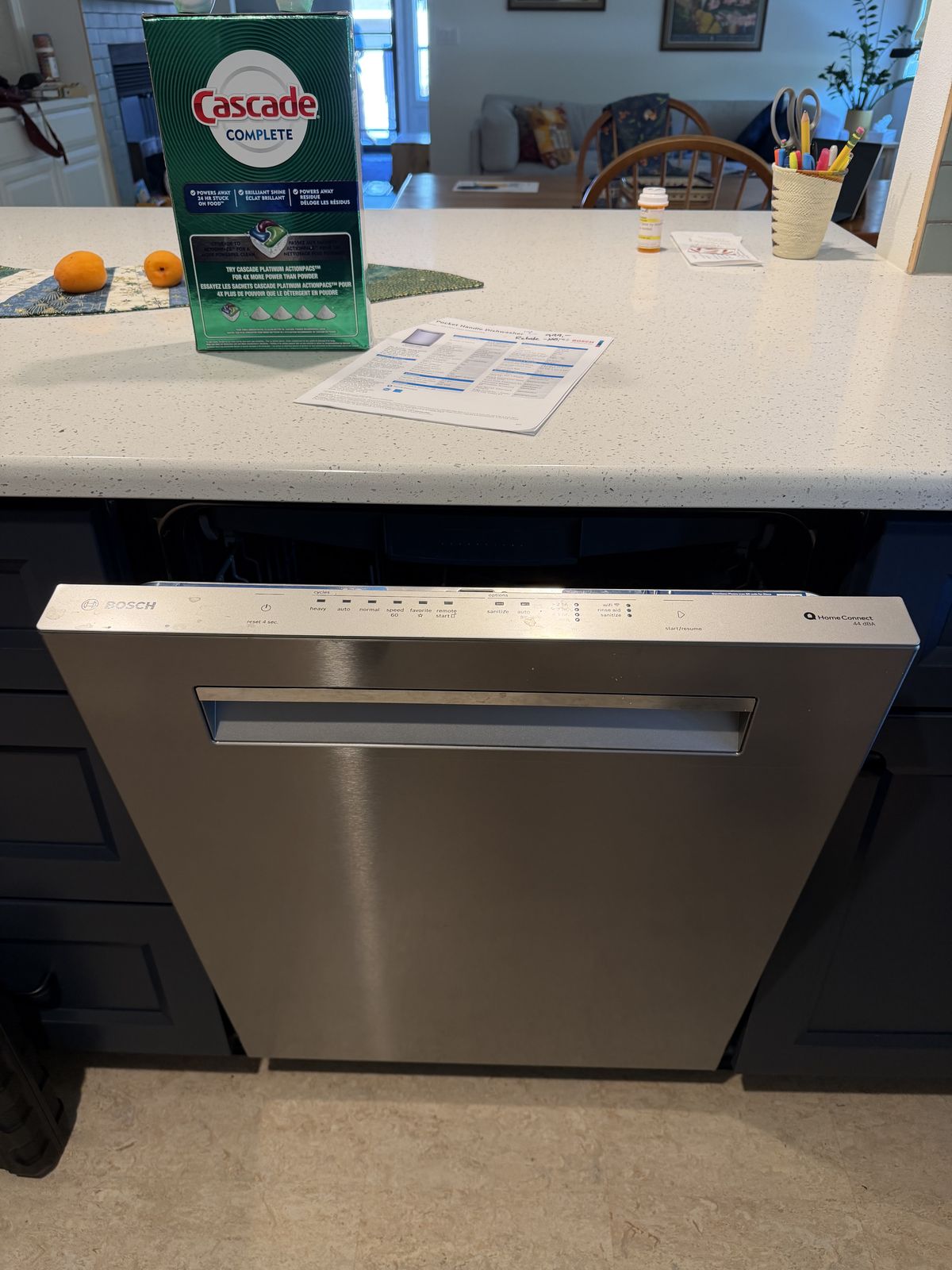
A dishwasher that quits in the middle of the week turns every meal into another stack in the sink. Our technicians repair built-in dishwashers in Olympia, Lacey, Tumwater, Yelm, Tenino and Rainier, from compact units in the condos by Percival Landing and remodeled kitchens in South Capitol and Northeast bungalows to builder-grade models in Hawks Prairie, Horizon Pointe and Tahoma Terra homes. Out past the city lines, many kitchens draw from private wells and drain to septic systems, which changes both what fails and the advice we leave behind. Whether your machine won’t drain, won’t start, leaks onto the floor or simply stops getting dishes clean, we take readings at the machine, explain what we found in plain terms, and quote one fixed price before any repair work begins.
Dishwashers hide most of their working parts under the tub and behind the toe kick, so we test before we take anything apart. We start with the simple checks that solve a surprising share of calls: the filter assembly at the bottom of the tub, the drain hose loop and air gap, and the disposal connection. Then we run the machine in its test or service mode and watch each stage. Fill tells us about the inlet valve and float switch; wash shows whether the circulation pump and spray arms are moving water; drain shows whether the drain pump and check valve are doing their part. We also check the incoming water temperature at the sink, since lukewarm supply water leaves even a mechanically sound machine struggling to clean.
Drain pumps, inlet valves, door latches, float switches, spray arms and door gaskets ride on our vans, so most dishwasher repairs wrap up in a single visit. When a repair means pulling the unit out of its cabinet opening, we handle that too, with a pad underneath so the floor finish stays unmarked. You see one written, fixed quote before anything is replaced. Should you approve it, the $97 we charged to diagnose comes off the final total; should you decline, that $97 is the entire cost of the visit. A control board or a pump specific to your model may need ordering; once it arrives we come back to put it in, and that return drive is not billed, and every repair ends with a full cycle run from fill through drain.
Dishwasher Problems We Diagnose and Repair
- Standing water after the cycle. We get more calls for a dishwasher not draining than for anything else: a dirty pool still in the tub at cycle’s end. The filter assembly under the lower spray arm is often packed with food, labels or broken glass. Beyond it, we check the drain hose for kinks, the air gap and disposal inlet for blockage, the check valve, and the drain pump motor, which can jam on a shard or simply stop running.
- Lights on, cycle won’t start. When the panel lights up but nothing happens, the control is usually waiting for a signal it never receives. Usually a worn door latch or its switch is to blame; after that we look at a child lock left engaged, a blown thermal fuse (on models that have one), or a control board fault. We test the latch switches for continuity, check the fuse, and read any stored error codes before going further.
- Gritty or spotty dishes. Grit left on the top rack and food baked onto plates usually mean water is not reaching them with enough force. Spray arm holes clog with seeds, glass chips and bits of label, and a packed filter starves the circulation pump. We clean the spray arms and filter, check that each arm turns easily, measure the incoming water temperature, and listen to the circulation pump as it runs.
- Cloudy, etched glassware. Cloudy glasses come from one of two causes, and only one wipes off. Mineral film rinses away with a vinegar soak. Etching, a permanent haze or rainbow sheen, is what happens when soft water like Olympia’s meets a heavy hand with the detergent. We look at your detergent, rinse aid and cycle choice, check water temperature and fill level, and confirm the machine drains and rinses fully.
- Water seeping onto the floor. A dishwasher leak can warp a wood or vinyl floor before anyone notices. We check the door gasket and lower door seal first, then the inlet valve and its fitting, the drain hose clamp, the pump seals and the tub sump. Hand dish soap or overdosed detergent can also push foam out past the door. Certain models also have a safety float in the base pan; once leaked water raises it, the cycle shuts down.
- Dishes come out wet and cool. Wet dishes at the end of the cycle can mean a failed heating element, a high-limit thermostat that opened, a temperature sensor out of range, or an empty rinse aid reservoir. Then again, a stainless tub with no visible element relies on condensation drying, and on those machines damp plastic containers are normal. We measure the element’s resistance, test the thermostat and sensor, and compare the result to what your model is built to do.

Dishwasher Parts We Test and Replace
- Drain pump. The drain pump sits under the tub and pushes used water out through the drain hose. Glass, bones and fruit pits can jam its impeller, and its motor eventually wears out. We check for debris at the pump inlet, measure the motor’s resistance, and run a drain test to confirm full flow.
- Circulation pump. This larger motor pushes wash water up through the spray arms. Worn bearings make it hum, groan or run weakly, and a failed motor leaves water sitting still in the tub. We listen to it run, measure the windings, and check the pump housing and seals for leaks before quoting a replacement.
- Water inlet valve. Mounted behind the toe kick, the inlet valve opens to let water into the tub. A weak coil causes slow or short fills, while a cracked body or debris caught in the seat lets it drip into the tub between cycles. We test the coil, time the fill, and inspect the screen for sediment.
- Door latch assembly. The latch holds the door closed and tells the control it is safe to start. Its plastic hooks wear, its switches stop making contact, and a door with tired springs may not catch at all. We meter every latch switch, check how the tub’s strike lines up, and adjust the door springs.
- Float and float switch. A small plastic float on the tub floor rises as water fills and cuts off the inlet valve before the tub overfills. If grease or food makes the float stick, the dishwasher may refuse to fill or keep overfilling. We clean around the float, confirm it moves smoothly, and meter the float switch.
Where our crew works
Dishwasher Repair across the South Sound, with same-day slots when the schedule allows. Tap a town for its page.
Soft Water, Iron Wells, Septic and Outages
Olympia’s city supply runs about 50 to 60 mg/L, soft enough that dishwashers inside city limits seldom scale up. The bigger risk is too much detergent: in soft water it oversudses, leaves residue in the sump and etches glassware for good. Lacey pulls from 20 or so municipal wells, soft in places and moderately hard in others, with iron and manganese edging over the aesthetic guideline in a few, and Tumwater’s wellfields are soft to moderate. On the private wells around rural Yelm, Tenino and Rainier, those same minerals stain tubs orange or brown and pack the inlet valve screen with sediment. Many of those kitchens drain to septic, where spacing heavy cycles helps. And a windstorm outage mid-cycle can leave water in the tub until the control is reset.
Dishwasher Brands on Our Route
If your dishwasher is still covered by the manufacturer’s warranty, contact the maker first; we will tell you that before booking. Outside that coverage, our technicians repair Bosch dishwashers, including the quiet European-style models found in many remodels; Miele; KitchenAid, Whirlpool, Maytag and Amana, which share many pumps and latches; GE, GE Profile and Café; LG and Samsung; Frigidaire and Electrolux; and the long line of Kenmore models still running in older homes. Panel-ready units that hide behind cabinet doors take extra care to remove, and we plan for that. The model number is usually printed on a label along the top or side edge of the inner door, visible when the door is open.
Repairing or Replacing a Dishwasher
A dishwasher is mostly pumps, valves, switches and a control, and nearly all of them can be replaced in a single visit. A drain pump, inlet valve, latch, float switch or circulation pump on a machine with a sound tub and racks is usually worth fixing. The balance shifts when the tub itself leaks through a crack or rust, when the racks are rusting and the control board has failed on a basic model, or when several major parts are wearing out at once. Built-in, panel-ready units lean toward repair, since replacing them means matching cabinet panels and openings. We give you our readings, the written quote and a plain account of the machine’s condition, and you make the call.
Care tip: Once a month, twist out the filter assembly at the bottom of the tub, scrub it gently with a soft brush under the warm tap, and lock it back in place. A clean filter keeps the circulation pump fed, eases the load on the drain pump, and prevents the sour smell that builds when food sits in the sump.
Service by town
Repair guides
Book dishwasher repair
One fixed quote after diagnosis. $97 diagnostic, applied to the repair if you go ahead.