Dryers Work Hard Where It Rains 160 Days a Year
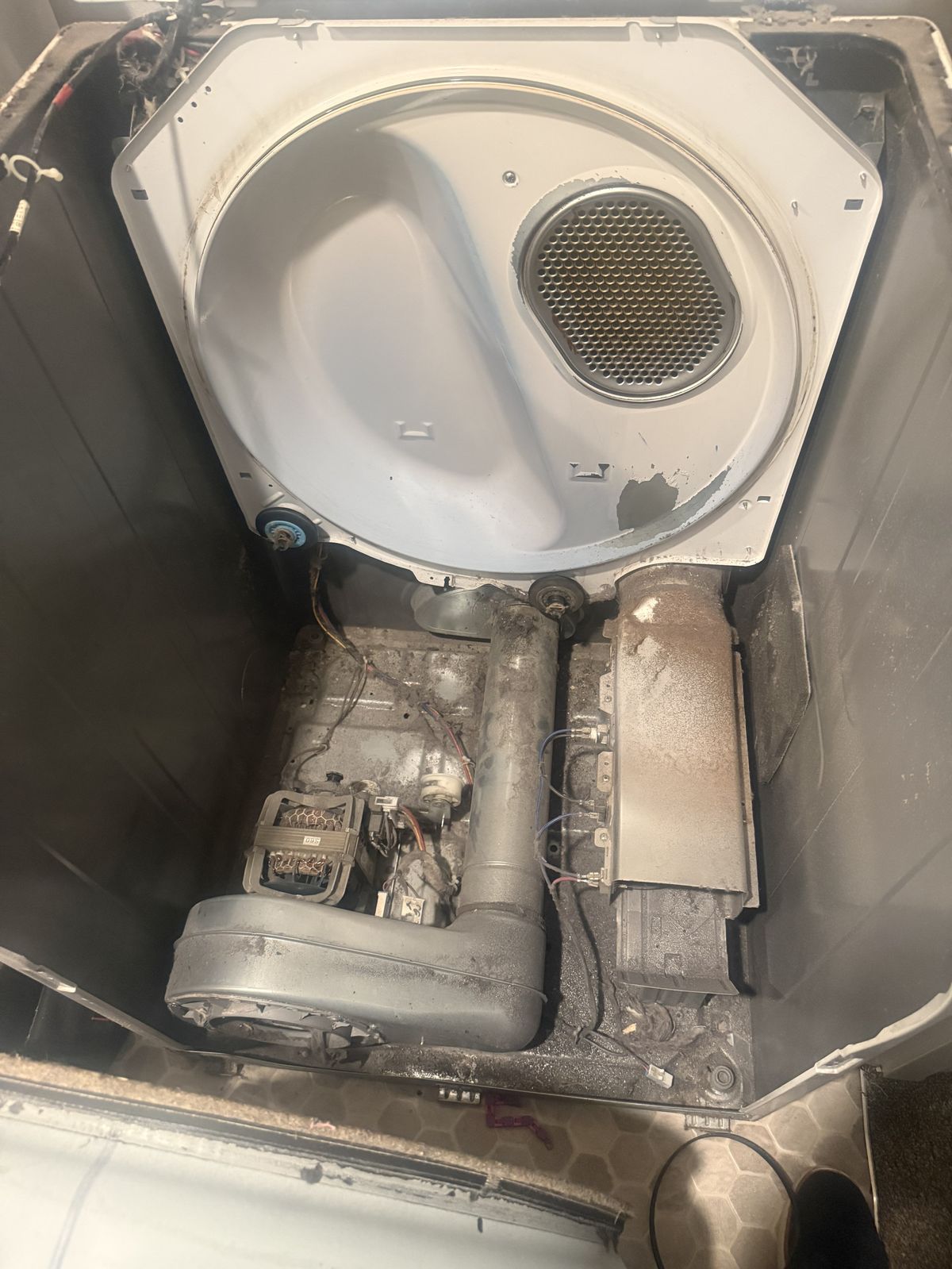
Around Olympia the dryer runs all year. With about 50 inches of rain spread over roughly 160 days, and November usually the wettest month, clothes rarely dry on a line, so a dryer that stops heating can bury a household in damp laundry within a day or two. Our technicians repair gas, propane and electric dryers across Olympia, Lacey, Tumwater, Yelm, Tenino and Rainier. Gas is how 35 to 44 percent of houses in Olympia, Lacey and Tumwater stay warm in winter, and the line that feeds the furnace often feeds a gas dryer too; out on the acreage near Yelm and the Littlerock Road corridor, the dryer usually draws from a propane tank. Condos, apartments and stacked closets lean electric almost everywhere. The three kinds break down differently, so our vans stock parts and meters for each of them.
Most calls fall into two groups: a dryer not heating at all, or heat that cannot get out. When an electric model has gone cold, we test continuity through the thermal fuse, the coil and the two thermostats that regulate and limit the heat, and confirm 240 volts arrives on each leg at the terminal block. On gas or propane, we time the igniter, see whether the flame sensor releases the valve, and read the resistance of the valve coils. For slow drying, the dryer is often fine and the vent is not, so we measure airflow and temperature at the outside hood on every heat-related call. A blown thermal fuse is a message about airflow, and replacing it without finding the restriction only sets up the next failure. We read the numbers and explain them before quoting anything.
Thermal fuses, heating elements, igniters, flame sensors, gas valve coils, thermostats, belts, idler pulleys and drum rollers all travel on our vans, which lets us close out a large share of dryer repairs in one trip. You receive a written, fixed quote before any part is replaced. The $97 diagnosis goes entirely toward the repair when you give us the go-ahead; if you choose not to proceed, the $97 pays for our time and the visit ends there. If the fix needs an ordered part, say a control board or a single-model motor, we return to install it and add no trip charge for that second stop. Before we leave, we run the dryer through a full heat cycle and recheck the exhaust temperature at the hood, so you know both the machine and its vent are doing their jobs.
Dryer Problems Our Technicians Fix
- Drum turns but no heat. A dryer that tumbles cold has lost its heat source or a safety device in the heat circuit. On electric models, four heat-circuit parts get a meter reading (fuse, element and both thermostats), and we verify the house is delivering 240 volts across both legs. On gas and propane models we look for igniter glow, confirm the flame sensor switches when it should, and see whether the valve coils pull the gas valve open.
- Loads need two cycles to dry. When towels come out damp after a full cycle, the problem is usually air, not heat. Moist air stays trapped in the drum when lint packs the duct, when the vent takes too many bends, when the foil hose gets flattened behind the dryer, or when moss and fir needles glue the flap shut. Before touching any heating part, we read the airflow coming out of the outside hood and look over the blower wheel.
- Shuts off while clothes are damp. On sensor-dry cycles, two metal bars inside the drum read moisture as clothes tumble across them. Dryer sheets and fabric softener coat those bars with a waxy film, and the dryer decides the load is done long before it is. We clean the sensor bars, test the sensor circuit, and compare a timed cycle with a sensor cycle to learn whether the fault sits in the bars, the harness or the control.
- Squealing, thumping or scraping. Dryer noises usually point to a single worn part. A high squeal that starts a few minutes into the load is often a dry idler pulley bearing. A steady thump-thump means worn drum rollers or one with a flat side. Scraping at the front means worn drum glides or a failed front bearing. With the drum out, we turn every roller and the pulley by hand, then swap worn pieces as a set.
- Won’t start at all. A dryer that stays silent when you press start may have a failed door switch, a blown thermal fuse that cuts power to the motor on many models, a broken belt that has tripped its belt switch, a worn start switch, or a motor that hums but will not turn. We confirm the breaker and outlet first, then test each switch in the start circuit and the motor windings.
- Hot or burning smell. Stop the dryer if you smell burning, pull the lint screen and leave the door open. A brief dusty smell when the heat first runs after weeks of light use is common, but a lingering scorched odor often means lint has worked onto the element or into the burner. We open the cabinet, clear lint from the blower housing and burner area, and check that every safety thermostat cuts out at the right temperature.

Dryer Parts We Test and Replace
- Thermal fuse. This one-time safety fuse opens when exhaust temperature runs too high, usually because of a restricted vent. Once it blows, the dryer loses heat or will not start at all, depending on the model. We confirm the open fuse with a meter, find the airflow problem behind it, and never bypass it.
- High-limit and cycling thermostats. The cycling thermostat switches the heat on and off to hold drying temperature, while the high-limit thermostat cuts the heat if the burner or element housing overheats. Either can stick open, leaving no heat, or drift and let the dryer run too hot. We test both cold and again while heating.
- Heating element. Electric dryers heat with a coiled wire element inside a metal housing. The coil can break, short against its housing, or burn through where lint has collected. We check resistance across the element, test for a short to the housing, and replace any thermostat that let it overheat along with it.
- Burner igniter, flame sensor and coils. Gas and propane dryers light with a hot-surface igniter that must glow before the gas valve coils open. When the coils weaken, the dryer lights and then goes out partway through the cycle. We time the igniter glow, check the flame sensor’s switching, and measure each coil’s resistance.
- Idler pulley, belt and drum rollers. The belt wraps the drum and runs past a spring-loaded idler pulley to the motor, while rollers carry the drum’s weight. Dry bearings squeal, worn rollers thump, and a cracked belt eventually snaps. We inspect each part with the drum out and replace worn pieces together so the drum runs quietly.
Where our crew works
Dryer Repair across the South Sound, with same-day slots when the schedule allows. Tap a town for its page.
Rain, Fog, Long Vent Runs and Outages
Our climate is hard on the path a dryer breathes through. With humidity near 80 percent, fall and winter fog, and rain on about 160 days a year, outside vent flaps swell and gather moss, and fir needles pile up until the flap barely opens. Ducts running through crawlspaces stay cool, so warm, moist exhaust condenses inside them and turns lint into a damp mat. Two-story houses often push exhaust a long way, up through the roof or out a distant wall, slowing the air. Steam dryers draw water too, and on rural wells outside Yelm, Tenino and Rainier their small inlet screens catch iron sediment. Gas dryers are common in the three core cities, propane on the rural edges, and windstorm outages leave some electronic controls needing a reset.
Dryer Brands We Repair
If the dryer is new enough to fall under the manufacturer’s warranty, start with that coverage; we will tell you so before scheduling. After that, our technicians work on Whirlpool, Maytag, Amana and Kenmore dryers in all three fuel types, a family sharing many drive and heating parts; GE and GE Profile; LG and Samsung, including steam and sensor-dry models; Electrolux and Frigidaire; Speed Queen; and compact Bosch and Miele units, including condenser and heat pump models that suit closets without an outside vent. We regularly work on stacked pairs and all-in-one laundry centers too. The model tag usually sits inside the door opening or on the back panel; send a photo when you book so we can match parts.
Keep the Old Dryer or Start Over?
At heart, dryers are built simply; nearly every part inside can be swapped: belts, rollers, pulleys, fuses, thermostats, elements, igniters, coils and motors. That makes repair the sensible choice for most dryers, even older ones. The cases that lean toward replacement are a drum or cabinet rusted through, a failed control board on a basic model that has also worn out its motor and bearings, or a gas dryer with a damaged burner assembly on top of other wear. One point applies to both paths: a new dryer connected to a clogged or crushed vent will blow its own thermal fuse and run long cycles too. We measure airflow either way and tell you whether the vent needs work before you decide anything.
Care tip: Empty the lint screen each time you start a load. Then, once a month through the wet season, go outside with the dryer running. The hood flap should swing fully open and push out a steady stream of warm air. If it barely moves, brush moss and fir needles off the hood, or call us to measure the airflow.
Service by town
Repair guides
Book dryer repair
One fixed quote after diagnosis. $97 diagnostic, applied to the repair if you go ahead.