Everyone pulls the lint screen. Far fewer walk around to the siding to see the exhaust exit, a small hood on the wall or roof that spends its whole life in South Sound weather: close to 50 inches of yearly rain falling on some 160 days, fall fog, wind that throws fir needles at the wall, and moss on anything that stays damp. When a dryer in Olympia, Lacey or Tumwater starts needing two cycles, our technicians check the outside flap early, because a surprising number of heat complaints end right there.
What the hood and damper are meant to do
The exterior hood caps the end of the vent run and holds a damper, either a single hinged flap or a stack of light louvers. When the dryer runs, exhaust pressure pushes the damper open. When it stops, gravity or a light spring closes it, keeping out rain, cold air, insects and birds. Residential building codes call for a backdraft damper at the termination and prohibit a screen there, because any mesh in the exhaust stream catches lint and closes up quickly. A healthy damper moves with a fingertip and falls shut on its own. Anything that stiffens that motion adds resistance to the entire run.
That resistance matters because a dryer is designed around a certain volume of airflow. Manufacturers publish maximum vent lengths that shrink with every elbow, and the style of exterior hood figures into that math as well. A house whose vent was already close to the limit has no margin left when the damper sticks halfway. The blower keeps pushing, the air in the drum gets hotter, the high-limit thermostat begins clicking the burner or element off and on, and every load takes longer. Over months, a restricted run can also overheat the thermal fuse until it opens, and then the drum turns while the air inside stays cold.
Rain, moss, paint and frost: how weather jams a flap
Around here, the jams follow the seasons. In the wet months, rain blows against the hood and soaks the lint that collects on the louvers, turning it into a gray paste that glues them partly shut. Moss creeps onto hoods on shaded, north-facing walls and can bridge the gap between flap and frame. Fir needles and maple seeds wedge between louvers. Thurston County averages around 78 freezing nights a year, and on any of them a wet flap can lock in place by morning. One cause has nothing to do with weather: a fresh coat of exterior paint often seals the flap to its frame, and the next load runs against a closed door.
Plastic hoods add their own wear. Hinges crack, and louvers on a sunny wall can warp in heat; the Olympia airport recorded 110°F during the June 2021 heat wave, enough to test any plastic hood. A broken flap may hang open for good, letting in cold, damp air that worsens condensation in the duct and giving birds an open invitation. Metal hoods last longer but can corrode at the hinge pin. Neither kind lasts forever. If yours is brittle, faded or missing louvers, replacing it with a well-fitting hood and a light, easy-swinging damper is reasonable homeowner work.
Condensation inside the run: crawlspaces, attics and two-story homes
The outside flap is only the end of the story. Exhaust leaves the dryer warm and loaded with moisture, and when it meets a duct running through a cold crawlspace, garage or attic, water condenses on the inside of the pipe. Lint sticks to that wet surface and builds into dense, heavy plugs, often at a low spot or an elbow. In older Olympia neighborhoods such as the Eastside, the Westside and South Capitol, vents often run under the floor before they exit. In Lacey and Tumwater homes built since 2000, upstairs laundry rooms push exhaust through long runs to a roof or high wall cap, which collects moss and needles too.
You can sometimes spot this from outside. Water dripping from the hood on a cold morning, dark streaks running down the siding below it, or clumps of wet lint stuck in the louvers all suggest moisture is settling in the run. Sags in a flexible duct hold water, so supporting the duct with a steady pitch toward the outside helps it drain. Ducts through unheated spaces do better as rigid metal with sealed joints, and insulating them can cut condensation. We look at these details on every heat-related dryer call, because clearing the flap without fixing a wet run only buys a few months.
Where our crew works
Tap a town on the map to open its page. Our crew covers Olympia, Lacey, Tumwater, Yelm, Tenino and Rainier.
Birds, wasps and other tenants in a warm pipe
A dryer vent is warm, dry and sheltered, and in spring that appeals to nesting birds, particularly starlings and sparrows. A flap stuck open or broken off is all the invitation they need, and a nest can fill a run within days, leaving a smell whenever the dryer heats it. Wasps sometimes build behind louvers in summer. If you see birds flying in and out, or hear scratching while the dryer is off, stop using the dryer until the run is cleared, since a full blockage pushes heat back into the machine. Resist the urge to staple screen over the opening; it catches lint and creates the very clog you are trying to prevent.
A five-minute airflow test from the outside wall
Clean the lint screen, load a few damp towels and run the dryer on high heat. After two or three minutes, go outside and hold your palm a few inches from the hood without reaching inside. You want a strong, steady, warm stream and a damper standing fully open. A weak lukewarm breeze, a flap that barely lifts, lint whiskers on the louvers or moss bridging the frame all point to the exhaust path rather than the dryer itself. When the cycle ends, watch the damper close. If the hood is on the roof or high on a two-story wall, skip the ladder on wet, mossy surfaces and let our crew check it.
If the flow outside is weak, the restriction can sit anywhere between the lint screen housing and the hood, and its location changes the fix. A clean, easy-moving flap with weak air behind it points to a clogged run or a crushed transition duct. Strong air with a stuck flap points to the hood itself. Strong air outside but a dryer that still struggles points back indoors, to the heat source or the moisture sensor. Note what you saw, along with how many cycles a towel load takes, and pass it along when you book. That short report often decides which parts ride along.
Your side of the job and ours
Homeowner work: brushing lint and needles off the hood, scraping paint off a sealed flap, trimming moss nearby, and replacing a cracked hood with one that seals properly against the siding. Behind the dryer, swap any white vinyl or thin foil transition duct for semi-rigid metal and keep it from being crushed against the wall. Unplug the dryer before moving it, and on a gas dryer, leave the gas connector alone; any whiff of gas means everyone leaves the house, and you reach the gas utility by phone from outdoors. Do not add screens, and do not run the dryer with the duct disconnected.
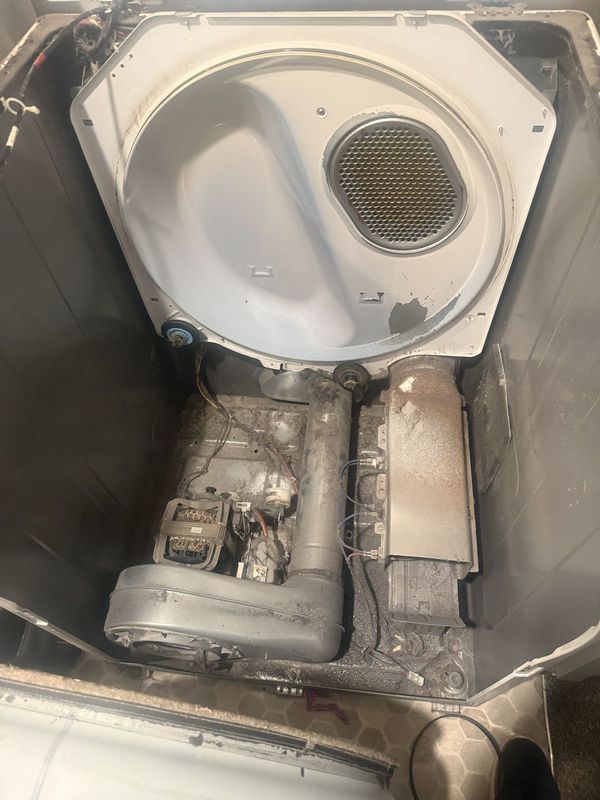
Our side starts with the dryer, because a long airflow problem rarely leaves it untouched. Our meter goes on the thermal fuse first, then the cycling and high-limit thermostats; after that comes the heat source itself, meaning the element on an electric unit or, on gas and propane models, the igniter and flame sensor. We clean the full run from machine to hood, open the blower housing where damp lint packs deepest, and measure airflow at the exit so the result is a number you can see. Around Olympia, Lacey and Tumwater, we finish every heat-related dryer repair at the outside wall, because in a climate this wet, that is often where the trouble began.
Care tip: Each fall, before the November rains arrive, start a load and go out to the hood to confirm the flap swings all the way open and drops shut by itself afterward. Brush off lint, needles and moss while you are there, and make sure no fresh paint has glued the damper to its frame.
Questions we get about this
How often should the outside vent be cleaned in a wet climate like Olympia's?
Look at the hood every few months and clear it whenever lint, needles or moss build up. A full cleaning of the run is worth doing about once a year in most homes, and sooner for big households, long runs, roof terminations or ducts that pass through a crawlspace. If drying time creeps up between cleanings, treat that as the signal rather than waiting for the calendar.
Can I put a screen over the vent opening to keep birds out?
Please don't. Any mesh in the exhaust stream catches lint and clogs, sometimes within weeks, and building codes prohibit screens at a dryer termination for exactly that reason. A sounder fix is a hood with a damper that closes fully when the dryer stops, so there is no open doorway for nesting. If birds have already moved in, clear the nest and repair or replace the damper before running the dryer again.
Why does water drip out of the vent hood on cold mornings?
That is condensation from the exhaust cooling inside the duct, and it is common here in winter. A little moisture after a cycle is normal. Steady dripping, dark streaks on the siding or wet lint in the louvers suggest a sag, a long run through a cold space, or a partial clog holding water. Supporting the duct on a steady slope to the outside and clearing the lint usually fixes it.
Dryer slow and the flap barely moves?
We clean, measure and repair from the dryer to the outside wall. The diagnosis is $97. Approve the work and every dollar of it goes toward the repair; turn it down and that $97 is your whole bill.