
Behind a pair of bifold doors in a Meridian Campus townhome, a downtown Olympia condo near Percival Landing or an upstairs hallway in Hawks Prairie, the laundry is often a single tower: washer on the floor, dryer bolted above it, a few inches of air on each side. The parts inside match the ones in side-by-side machines. What changes is how the closet treats them. A tower shakes harder, hides its leaks, breathes through a cramped vent and takes care to open up. Here is what tends to fail first and how our crew handles it.
Stacked pair, laundry center or combo: which tower is yours
Three different machines get called a stacked washer-dryer, and the difference shapes the repair. A stacked pair is two separate front-load machines joined by a stacking kit, a set of brackets that locks the dryer's feet to the washer's top. Each has its own cord, controls and model sticker. A laundry center is one cabinet with a top-load washer below and a dryer above, built on a shared frame and often powered through a single cord; Whirlpool, Maytag, GE and Frigidaire all build them. A washer-dryer combo is one drum that washes and then dries, with no outside vent at all. Find the model sticker before you call.
The 24-inch compact pairs from Bosch, Miele, LG, Samsung and Electrolux deserve a mention, since they show up in condos and newer townhomes where space is tight. Many compact dryers are ventless condenser or heat pump designs, which handle lint and moisture inside the machine instead of blowing them outdoors. That changes the cleaning routine and the list of likely failures. Full-size 27-inch pairs are more common in houses and usually vent outside. Knowing which of these you have lets us bring the right stacking hardware and the parts that fail most on that design, and it tells us whether the dryer will need to come down.
Vibration and walking: the tower's leading complaint
A tall stack magnifies every unbalanced spin. The washer's shock absorbers, dampers and suspension springs wear, the drum swings farther, and the whole tower starts to rock, thump against the closet walls and creep forward. Leveling feet back out over time, and a stacking kit with loose screws lets the dryer chatter on top. Upstairs closets on wood framing flex more than a concrete slab, which adds to the motion. When we see a walking tower, we check the shocks and springs, the drum bearings for play, the feet and the stacking brackets, and we finish by leveling the pair as a single unit.
Some vibration starts with the load. Small closets tempt people to stuff the drum, and a lone bath mat or a king comforter can throw a front-loader badly out of balance. A brand-new pair that shakes violently on its first spin often still has its shipping bolts in the back of the washer; those bolts lock the drum for transport and must come out before use. Rubber anti-vibration pads help on some floors but cannot make up for worn suspension parts. If the dryer door pops open during the washer's spin, or the top machine visibly shifts, stop using the tower until the brackets are checked.
Venting a dryer that sits six feet up
With the dryer on top, the exhaust leaves high on the wall, and the transition duct behind the tower is easy to crush when the stack gets pushed back into the closet. Flexible foil ducts kink, and a kinked duct cuts airflow just as badly as a clogged one. In this climate that matters more than it would elsewhere. Damp exhaust meeting cold duct sections in crawlspaces or exterior walls leaves condensation behind, and wet lint packs into heavy plugs. The results are familiar: loads that need two cycles, a cabinet hot to the touch, and eventually a blown thermal fuse, which is a warning to trace, never a part to bypass.
The closet itself can starve a dryer. Manufacturers call for openings or louvered doors on closet installs so the dryer can pull in fresh air, and a solid door shut tight during a cycle cuts its intake. Keep the doors open or louvered, keep the space behind the tower clear, and use semi-rigid metal duct rather than vinyl or thin foil. On a gas dryer, the gas line and shutoff sit behind the stack too. If you ever smell gas in or near the laundry closet, do not flip switches or unplug anything; leave the home and call the gas utility from outside.
Where our crew works
Tap a town on the map to open its page. Our crew covers Olympia, Lacey, Tumwater, Yelm, Tenino and Rainier.
The slow leak no one sees from the hallway
A floor-standing washer that drips leaves a puddle you notice. Put that same washer in a closet beneath a dryer and the water slips out of sight, creeping beneath the cabinet toward the subfloor; in a condo or townhome, a stain on the ceiling downstairs may be the first anyone hears of it. Common sources are a door boot with a split fold, a drain hose clamp that has slipped, a hardened fill hose washer, or a front-loader's pump filter cap that was not fully seated after cleaning. Watch for a musty smell in the closet, swollen baseboard, vinyl lifting at the threshold, or dark mildew growing where the rubber door boot folds back on itself.
If you suspect a leak, turn off both water valves behind the tower and run nothing until the source is found. Check what you can safely see with a flashlight: the hose connections at the wall, the front filter cap and the bottom of the door boot. On every stacked call, our technicians trace water under and behind the tower, and if you mention water when you book, we move that visit up the list where the schedule allows. Laundry rooms stay damp in this part of Thurston County, so leaving the washer door ajar between loads helps the boot dry and keeps mildew down.
Washer-dryer combos follow their own rules
An all-in-one combo washes and dries in the same drum and condenses moisture out of the air instead of venting it. Long drying times are part of that design, not a defect, and a combo dries a smaller load well than it can wash. The trouble spots differ from a stacked pair. The condensing path collects lint sludge, the drain pump handles both wash water and condensate, and a clogged pump filter shows up as a draining error and a drying complaint at the same time. Combos repair well when the service data for that exact model is in hand, which is why we ask for the model number before the visit.
Taking a tower apart safely and putting it back right
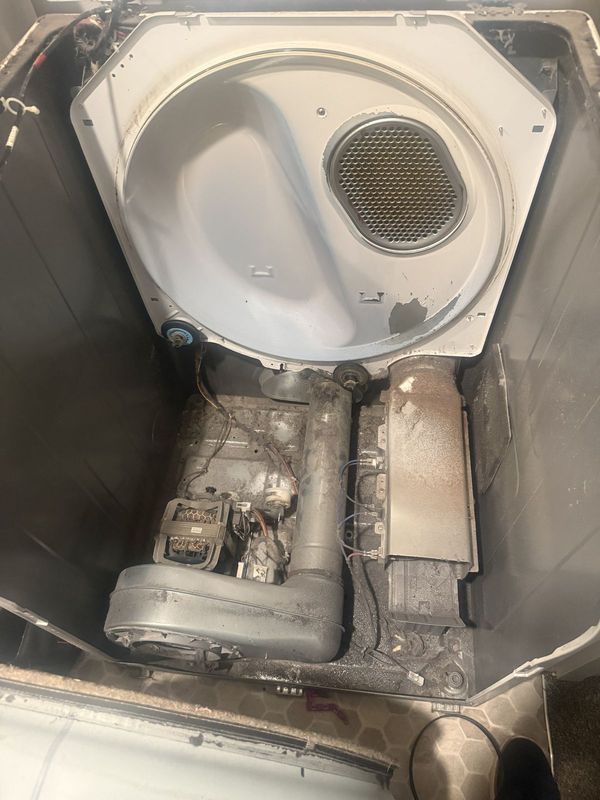
Half of a stacked repair is safe access. We shut off water, power and gas where it applies, protect the floor and slide the tower out of the closet. Many repairs on either machine happen with the pair still stacked. Deeper washer work, such as a tub bearing, a door boot or a suspension change, means two people lift the dryer down, set it aside and reinstall it with the stacking kit tightened. Before we leave, the tower is leveled as a unit, the vent connection is checked and the washer runs a test spin with a load inside. If the pair is still under the maker's warranty, call the manufacturer first.
Care tip: Twice a year, shine a flashlight under the washer and along the back of the stack, check the hose connections at the wall, and wipe the door boot dry. Then press on the top corners of the dryer. If it shifts, the stacking brackets need tightening before the next heavy spin.
Questions we get about this
Does the dryer have to come off the stack before the lower washer gets repaired?
Usually not. Once the tower slides out of the closet, a technician can reach the drain pump, the inlet valve, the door lock, the hoses and most control parts while both machines stay stacked. Work inside the washer tub, such as bearings, a new door boot or suspension springs, normally means lifting the dryer off. Our crew brings the extra hands and the stacking hardware for that, so it can still be a one-visit repair.
If half of my laundry center fails, do I have to replace the whole unit?
No. The washer and dryer sections of a laundry center are repaired separately, like standalone machines, using parts listed for that model. A broken drive belt in the dryer half or a worn lid switch on the washer half is an ordinary repair. Replacement usually comes down to age and the condition of the shared frame and tub, and we lay out that comparison in writing before any work begins.
Should I keep using the stack if water keeps showing up on the closet floor?
Stop using it. Shut off both supply valves behind the tower, switch off the laundry circuit at the breaker if the floor is wet, and dry the area. Water in a closet travels under the cabinet and into framing, and in a condo it can reach the unit below. Note when the water appears, during fill, wash or drain, because that timing tells our technicians where to look first.
Tower shaking, leaking or slow to dry?
We pull the stack out, find the fault and quote it in writing. Our $97 diagnosis is credited entirely to the repair when you go ahead; say no, and the $97 is the whole bill.