Olympia dryer service that follows the air all the way out

Heat, a turning drum and a clear exit for wet air: a dryer needs all three, and in Olympia it is the exit that lets people down most often. The typical house in town dates to the early 1980s, and close to half of the city’s homes predate 1980, so dryer ducts here wander under floors, rise through second stories and poke out beneath decks. Over the years those ducts gather lint, droop where sections meet and, in this damp climate, collect condensation that mats the lint into something like felt. Push a dryer against that kind of restriction and it overheats, opens its high-limit thermostat and eventually pops the thermal fuse, while a load of bath towels ends up needing a second round. That is why our technicians take an airflow reading where the vent leaves the house, not only meter readings on the heat parts inside the cabinet.
Plenty of Olympia laundry rooms burn natural gas, since Puget Sound Energy pipes it across most of the city, and a few houses near the edges fuel their dryers with propane. With a gas model, our meter goes on the igniter, the flame sensor, the valve coils and the thermal fuse in turn. On electric models the sequence covers the heating element, the cycling thermostat, the high-limit, the fuse and then the timer or control. Either type can wear out belts, idler pulleys, drum rollers, front glides and door switches as the years stack up. Brands on our Olympia route include Maytag, Whirlpool, Kenmore, GE, Samsung, Speed Queen, LG, Frigidaire, Amana and Electrolux, stacked pairs and laundry centers among them, and the parts they need most often travel with us. One habit we never break: a blown thermal fuse gets diagnosed, never jumped, because something made it open.
Fog, rain and long vent runs in Olympia
In a dryer, the trouble with water arrives through the air rather than the plumbing. Close to 50 inches of rain lands on Olympia over some 160 days a year, fog settles in from October through the winter, and relative humidity hovers around 80 percent. Ducts crossing a chilly crawlspace sweat, and soggy lint piles up wherever the run dips. At the wall, the hood flap swells, sticks or gets glued shut with moss and fir needles, so damp outdoor air drifts back toward the drum. Fuel is the second local factor. Gas furnaces account for 35 to 44 percent of home heating in the three core cities, so a gas stub behind the dryer is common. Any gas odor near the laundry means getting everyone outdoors first and phoning the utility from there, then us.
Dryer calls by Olympia neighborhood
- Eastside. On the Eastside, older houses tend to tuck the dryer into a basement or a back-porch addition, and the duct bends several times on its way to an exterior wall. Crushed foil connectors and lint wedged into every elbow are standard finds there. We open up the whole exhaust route and clean it out before any heating part gets a test.
- Westside and Goldcrest. Westside and Goldcrest ramblers usually send dryer exhaust under the floor and out a side wall. Given enough years, those crawlspace runs droop, and the low point holds standing water, most of all in November, the rainiest month here. We hunt for pulled-apart joints and wet lint beneath the house, then meter the thermostats and the fuse.
- Boston Harbor. Properties near Boston Harbor sit under big firs, and needles and moss build up on wall and roof hoods alike. When the flap cannot swing all the way open, the dryer suffocates, and screened hoods sometimes host a bird’s nest. Propane is common out this way, so we verify the dryer carries the right conversion for that fuel, test the igniter and watch the burner catch.
- Cooper Point. Bigger houses off Cooper Point Road sometimes keep the laundry on an upper floor, with exhaust rising through attic space to a cap on the roof. In a tall vertical run, lint falls back toward the machine and the blower has to labor. We read airflow at the roof cap, clean out every section within reach and put a meter on the high-limit thermostat.
Where our crew works
We cover all of Olympia, from South Capitol, Eastside, Westside and Goldcrest, Northeast and Bigelow to the streets between. Tap a town on the map for its page.
Dryer trouble we find in Olympia
- Two cycles on a crawlspace vent. Towels that need a second run during the rainy season point at the vent before anything else: wet lint sitting in a crawlspace duct, or a hood flap that stays shut. We take an airflow reading and then check the heat source and thermostats, since a choked duct and a weak heater can mask each other on one machine.
- Older-home gas dryer tumbles cold. When a gas dryer tumbles cold, we watch through the burner window as it calls for flame. If the igniter turns orange and then dims without lighting the gas, the valve coils become the suspects. With no glow at all, the igniter goes on the meter, then the flame sensor and thermal fuse. Nothing gets replaced until it fails a reading.
- Scorched smell from a sagging duct. A hot, scorched odor suggests lint has drifted near the burner or element, or has packed into a sag in the duct. Shut the dryer off, empty the lint screen and give us a call. We open the cabinet to clean around the heat source, follow the duct through the crawlspace and test the high-limit thermostat.
- Thumping drum in a basement laundry. Most thumps, squeals and scrapes come from a flat-spotted support roller, a dry idler bearing or a worn-through front glide. Older Olympia laundry rooms often hold dryers with long service records, and those parts tend to give out as a group. We take the drum out, inspect each one and replace whatever is worn so the noise stays away.
- Electric dryer cold on an old circuit. An electric dryer can only heat when both legs of its 240-volt circuit arrive. In older Olympia houses, a tired double-pole breaker or a burned cord terminal can lose one leg, so the motor keeps turning while the element sits dead. Our first reading is taken where the cord lands on the dryer; the element, thermal fuse and thermostats come after that.
A dryer visit from start to finish
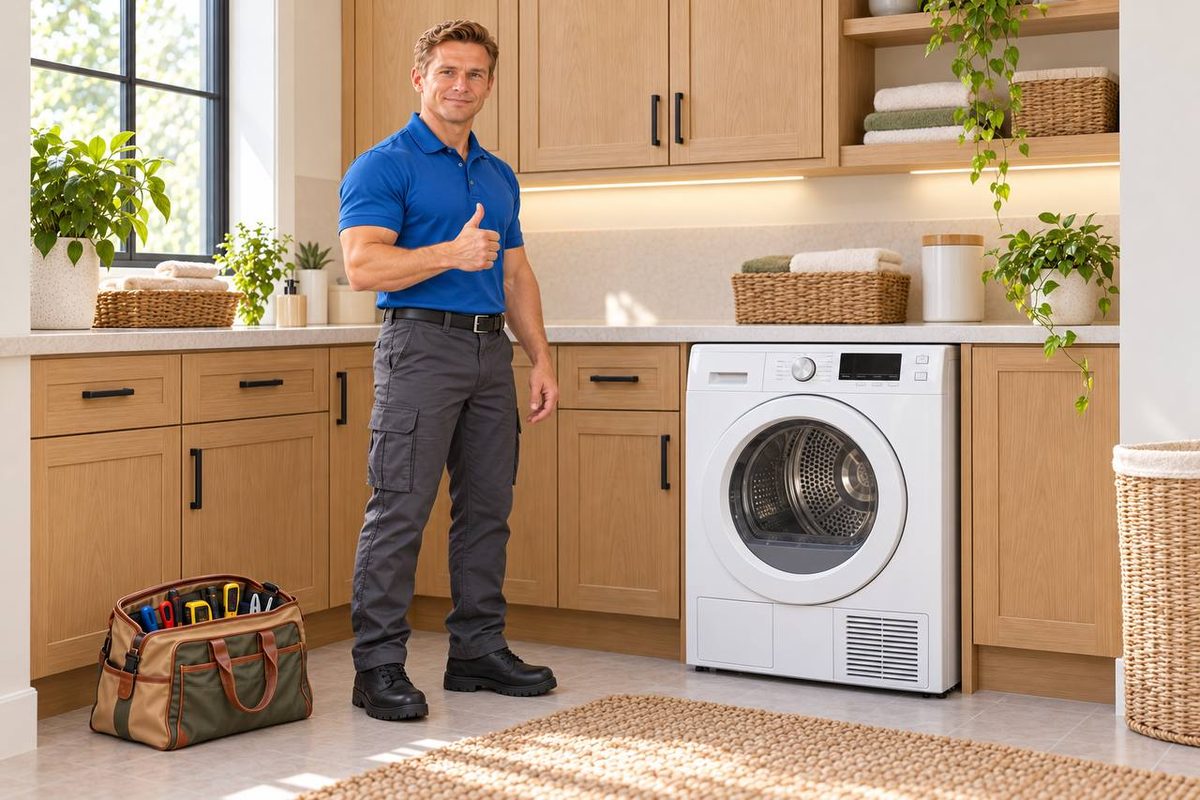
When you book, let us know the fuel your dryer uses and where its vent travels, whether under the floor, up through the attic or straight out a wall. Our technician begins at the supply, power or gas, and takes an airflow reading outdoors, then opens the cabinet to test the heat circuit, the belt, the rollers and the switches. Before anything gets replaced, you receive one written quote at a fixed price. The diagnostic costs $97; it folds into the price when you choose the repair, and if you stop there, $97 is the single charge. We stock igniters, thermal fuses, thermostats, belts and drum rollers on the van, so many dryers run again that afternoon. When the vent needs more than a cleaning, we walk you through what turned up so the next step is yours to schedule.
When an Olympia dryer is worth keeping
Most dryer failures involve parts we carry: thermal fuses, igniters, valve coils, elements, thermostats, belts and rollers. If the drum and cabinet are solid, gas or electric, the repair usually makes sense. Replacement starts to win when the drum has rusted through, the motor has quit on an aging machine or the maker has stopped producing its control board. Before buying a new dryer for an older Olympia house, get the vent looked at, since a new machine on a clogged duct will fail the same way the old one did. Any manufacturer coverage still in force is the first thing we bring up.
Care tip: Empty the lint screen after every load. Each season, unplug the dryer, slide it forward and look at the flexible duct behind it for kinks and lint. Then go outdoors with the dryer running and make sure the hood flap swings open. Clear off moss or fir needles before November’s heavy rain arrives.
More repairs in Olympia
Same repair nearby
Repair guides
Book a repair in Olympia
One fixed quote after diagnosis. $97 diagnostic, applied to the repair if you go ahead.