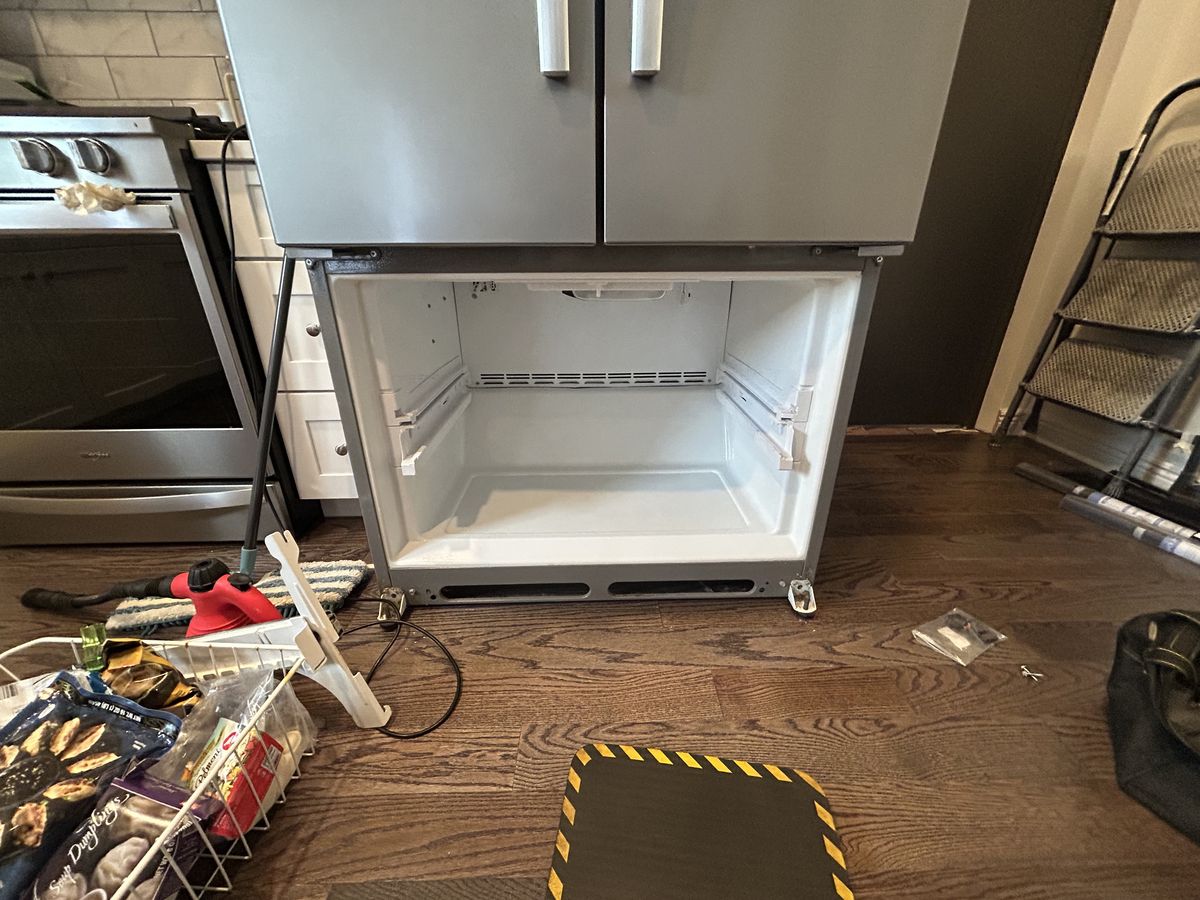
Soft ice cream is usually the first witness. The fresh-food side still keeps the milk cold, so the refrigerator seems fine, but the freezer has slipped from rock-hard to bendable and the frozen peas no longer rattle. This split is more useful than a total failure, because it rules out a dead compressor or a tripped breaker and narrows the search to a handful of causes. Some are household fixes that take five minutes. Others need a meter, a probe thermometer and a technician. Here is how our team tells them apart.
Why a split temperature is a useful clue
In the typical household refrigerator, a single evaporator coil hidden behind the freezer's rear panel produces every bit of cold the appliance uses. Air blown over that coil by the evaporator fan chills the freezer first; a damper, which some makers call an air door, then meters a portion of it down a channel to the fresh-food side. The freezer asks the most of the system, since it needs to hold about 0°F while the fresh-food side only has to stay at or below 40°F. So when cooling capacity slips a little, the freezer tends to show it first, while the fridge side still reaches its easier target.
Some refrigerators, including a number of French-door and built-in models, use separate evaporators and fans for each compartment. On those, a freezer-only problem often points straight at the freezer's own fan, coil or temperature sensor. Either way, the pattern tells us cooling hasn't stopped; it has weakened or gone to the wrong place. The model and serial numbers on the sticker inside the fresh-food compartment let our technicians confirm which design you have before they arrive, which shapes the parts they load. Snap a photo of that sticker when you call us.
Garage refrigerators on cold winter nights
This one catches plenty of South Sound households every winter. Temperatures dip below 32°F on roughly 78 nights in an average year here, and during a cold snap an unheated garage in Tumwater, Lacey or the prairie towns can stay near that mark for days. Many refrigerators decide when to start the compressor from a sensor or thermostat on the fresh-food side. Chilly garage air keeps that side satisfied, so the control seldom asks for cooling and the compressor rests. Meanwhile the freezer, which only gets cold while that compressor is working, creeps up from 0°F as the fresh-food side looks perfect.
Some models are rated for garage use or accept a garage kit, a small heater that keeps the control calling for cooling; your owner's manual will say. Otherwise, the reliable fix is moving the refrigerator into a heated space for the cold months or switching to a freezer built for unheated rooms. Summer brings the opposite strain. When the Olympia airport recorded 110°F in the June 2021 heat wave, garage units ran nearly nonstop. Heat that extreme exposes weak compressors and dusty condenser coils, and the damage can surface months later as a freezer that never fully recovers.
Airflow suspects: evaporator fan, damper and frost
Open the freezer and listen. On most models the evaporator fan stops when the door opens, so press and hold the door switch, usually a small button or lever on the frame, and listen for a steady whir behind the back panel. Silence, chirping, grinding or a fan that starts and stalls suggests a failing fan motor or ice catching the blades. A weak fan moves less air across the coil, and the freezer temperature drifts; the fresh-food side may not follow until later. If you hear the blades scraping ice, that ice came from somewhere, which leads straight to the defrost system.
A damper stuck wide open sends too much cold air into the fresh-food compartment, so that side runs colder than its setting, sometimes freezing lettuce in the crisper, while the freezer runs short. Defrost trouble belongs on the list too, though it more often shows up as a warm fridge side first. When a defrost heater, thermostat or sensor fails, frost slowly packs the coil. Heavy white frost on the freezer's back panel, gurgling or whistling air sounds and a problem that worsens over days all point to defrost. Skip the manual defrost as a fix; it erases the evidence and the frost comes back.
Where our crew works
Tap a town on the map to open its page. Our crew covers Olympia, Lacey, Tumwater, Yelm, Tenino and Rainier.
Five-minute checks at the freezer door
Start with an appliance thermometer in the middle of the freezer, left in place for several hours; you are looking for a reading near 0°F. Then look at the door. On top-freezer and side-by-side models, a package or ice bin sitting slightly forward can hold the door just off its seal. On bottom-freezer drawers, a basket off its track or a rail packed with spilled crumbs can stop the drawer short of closing. Run a strip of paper around the freezer gasket and tug it at intervals; anywhere it slides out with no drag is a leak. Frost on the inside edge of the door confirms it.
Packing matters as well. Freezer vents usually sit on the back wall or ceiling, and a full load stacked against them blocks circulation. Leave a little space in front of the vents and avoid laying tall bags flat across the back panel. Check the controls too: someone may have nudged the freezer setting warmer while cleaning, or switched on a vacation or energy-saving mode. Last, with the refrigerator unplugged, pop off the kick plate and inspect the condenser coil, which sits beneath the cabinet on some models and across the back on others. A blanket of dust and pet hair there makes the whole system run hotter and weaker; a coil brush and a vacuum clear it.
When the cooling system itself is losing ground
If the doors seal, the fans run, the coil is clear of frost and the freezer still can't reach 0°F, the sealed system moves up the list. A slow refrigerant leak or a compressor losing efficiency shows up first as a freezer that stalls a few degrees too warm while the compressor runs for long stretches without a break. The fresh-food side often holds for a while because its target is easier. A failing start relay or a control board weakened by power surges can also cut run time short, and the outages and flickers that come with fall and winter windstorms are a common source of that damage.
Sealed-system repair means refrigerant handling, brazing and recovery equipment, so it stays with our technicians. What you can do is note the symptoms: how long the compressor runs between rests, whether it hums, clicks or stays silent, and whether the freezer reading is steady or slipping day by day. Until the visit, limit door openings to quick trips and let the refrigerator keep running, unless it smells hot or trips a breaker. Your notes help our technicians decide whether a repair makes sense. On an older refrigerator, a sealed-system failure can tip the decision toward replacement, and we say so plainly rather than quoting a repair that won't pay its way.
Pinning down a freezer-only problem in one visit
At the house, our technicians probe both compartments, then take off the freezer's back panel; how frost has formed on the evaporator, patchy, packed solid or missing, frequently points to the cause by itself. They meter the defrost heater, its thermostat or sensor and the control that drives them, verify the evaporator and condenser fans, command the damper open and closed, and check the compressor's current draw and start components. Evaporator fans, defrost parts and dampers are regular van stock, so many of these repairs finish the same day. Warming refrigerators and freezers get priority on our same-day schedule whenever it allows.
Care tip: Keep an appliance thermometer on the middle shelf of the freezer and glance at it whenever you grab something. A reading that creeps above 0°F over several days is your early warning, well before the ice cream softens. If the refrigerator lives in the garage, check it more often during cold snaps.
Questions we get about this
Should I just turn the freezer control colder?
One notch colder is fine as a test, but it rarely fixes the cause. When the real trouble is a jammed damper or a frost-choked coil, a colder dial can overchill the fresh-food side and freeze produce while the freezer stays soft. Use a thermometer, check the door seal and vents, and if the freezer can't hold near 0°F after a day, have it diagnosed.
Why does the freezer on our Tumwater garage fridge go soft only in winter?
Most likely the refrigerator's control senses the fresh-food compartment, and cold garage air keeps that side satisfied, so the compressor rarely runs and the freezer warms. Nothing is broken. Look in the owner's manual to see whether the model is garage-rated or takes a heater kit; if not, bring it indoors through winter, or keep frozen food in a standalone freezer made to run in unheated spaces.
Is the frozen food safe while I wait for the repair?
Partly thawed items can go back into a repaired freezer as long as ice crystals remain in them or a thermometer shows 40°F or colder, though quality may drop. Discard any perishable that has sat warmer than 40°F for over two hours. If the freezer keeps warming, shift its contents into another freezer or an ice-filled cooler, and open the refrigerator only when necessary.
Freezer soft while the fridge holds?
A freezer that is losing cold gets bumped ahead on our same-day list whenever the day has room. The $97 visit finds the cause; approve the written quote and that amount comes off the repair, or decline and owe nothing further.