Refrigerator service in Olympia that starts with a thermometer

A refrigerator creeping from 37°F toward 50°F cannot wait for a convenient day, which is why our Olympia dispatch moves warming units ahead of other calls. Same-day arrival is common when the schedule has an opening, and the technician’s first move is a probe thermometer, not talk about parts. Both compartments get a temperature reading, we listen at the back for the compressor and inside for the evaporator fan, look over the condenser coils and feel along each door gasket, all before forming an opinion. Olympia’s housing shapes what we find. With almost half of Olympia’s houses older than 1980 and around one in nine older than 1940, many refrigerators stand in kitchens that were never meant for a 36-inch French-door unit and plug into circuits shared with a toaster, a microwave and a coffee maker.
That mix produces its own patterns. Built-in cabinetry in a remodeled bungalow can choke the airflow a condenser needs to shed heat. A second refrigerator in a basement or garage fights cold winter air and damp summer air in the same year. Ice makers and door dispensers fed by long copper or plastic lines through old walls develop slow leaks nobody sees until the floor goes soft. Every common layout comes through our hands: French-door, side-by-side, freezer-on-top and freezer-on-bottom models, counter-depth units, compact undercounter fridges, chest freezers and uprights. Brands we open most weeks in Olympia include Whirlpool, GE, GE Profile, Frigidaire, KitchenAid, LG, Maytag, Amana, Kenmore and Sub-Zero. Evaporator fan motors, defrost heaters, start relays and thermistors ride on the van, so a good share of refrigerator jobs here wrap up in one visit.
Soft water, damp air and older wiring in Olympia
Olympia draws most of its tap water from the McAllister Wellfield; measured hardness sits near 50 to 60 mg/L, so very little scale ever reaches a refrigerator’s inlet valve. The bigger factors are air and electricity. Humidity sits near 80 percent much of the year, and fall fog rides into the cabinet every time a door opens, loading the evaporator with frost and making tired gaskets sweat. Older homes add circuit trouble: a refrigerator sharing a decades-old kitchen circuit can see voltage dip when other loads kick on, and the start relay pays for it. Fall and winter windstorms knock out Puget Sound Energy power, and a fridge that hums but never restarts afterward is a regular call. Garage units also face roughly 78 freezing nights a year.
Refrigerator calls around Olympia neighborhoods
- South Capitol. Historic homes near the Capitol campus often have kitchens fitted around a modern refrigerator decades after construction. We find units boxed in by custom cabinetry with no breathing room at the top or back, so the condenser runs hot and the compressor cycles long. Restoring that airflow and confirming steady outlet voltage are part of every call here.
- Northeast and Bigelow. Across Bigelow and Northeast Olympia, bungalow owners often run an extra refrigerator in the basement or on a back porch. Those spots run damp, and condenser coils collect dust that turns to paste in humid air. We clean the coils, clear mildew from the defrost drain and test the door seal before anyone starts talking about a new unit.
- Cooper Point. Homes along Cooper Point Road range from wooded lots to newer builds with large kitchens, so we see many counter-depth and French-door units with a door dispenser for water and cubes. Supply-line leaks behind these units are a regular find. We trace the water line, test the inlet valve and inspect the drain pan before a drip reaches the flooring.
- Boston Harbor. Out toward Boston Harbor the drive is longer, so we stock the van for these calls. Garage and chest freezers are common on larger lots, and after a windstorm they are the units that refuse to restart. We test the start relay, overload and thermostat first. Homes on well water also get the filter checked for iron sediment.
Where our crew works
We cover all of Olympia, from South Capitol, Eastside, Westside and Goldcrest, Northeast and Bigelow to the streets between. Tap a town on the map for its page.
Refrigerator problems we see in Olympia homes
- Milk warming while ice cream stays hard. When the freezer holds near 0°F but the fresh-food side climbs, the evaporator fan or a frost-choked coil is the usual suspect. In older Olympia kitchens we also check whether the outlet shares a circuit with heavy loads. We measure both compartments, inspect the coil and test the fan motor before quoting.
- Frost wall after weeks of fog. A sheet of frost on the freezer’s back panel after a run of foggy fall weeks points to moist air slipping past a gasket or a defrost system that has quit. Our technician meters the defrost heater and its thermostat, sees whether the board is calling for defrost, then checks the whole gasket, hinge side included.
- Sweating cabinet in a damp basement. Beads of water on the outside of the cabinet or along the door edge of a basement refrigerator usually mean a weak seal, or on side-by-side models, a failed mullion heater between the doors. A paper slip shut in the door finds weak seal spots; we also meter the heater, level the cabinet and check condenser clearance.
- Will not restart on older wiring. A refrigerator that clicks, hums or stays silent after the power returns often has a failed start relay or overload, and sometimes a control that did not reboot cleanly. On older Olympia wiring we check the outlet and circuit first, then test the compressor’s start components. Relays and overloads for common models are on the van.
- Puddles under crispers in wet months. Water pooling under the crisper drawers or seeping onto the floor usually traces to a clogged defrost drain or a cracked water line. During Olympia’s damp months that drain can grow a slime plug that freezes over. We thaw and flush that drain line, then check the heater clip, the drain pan and the supply fittings.
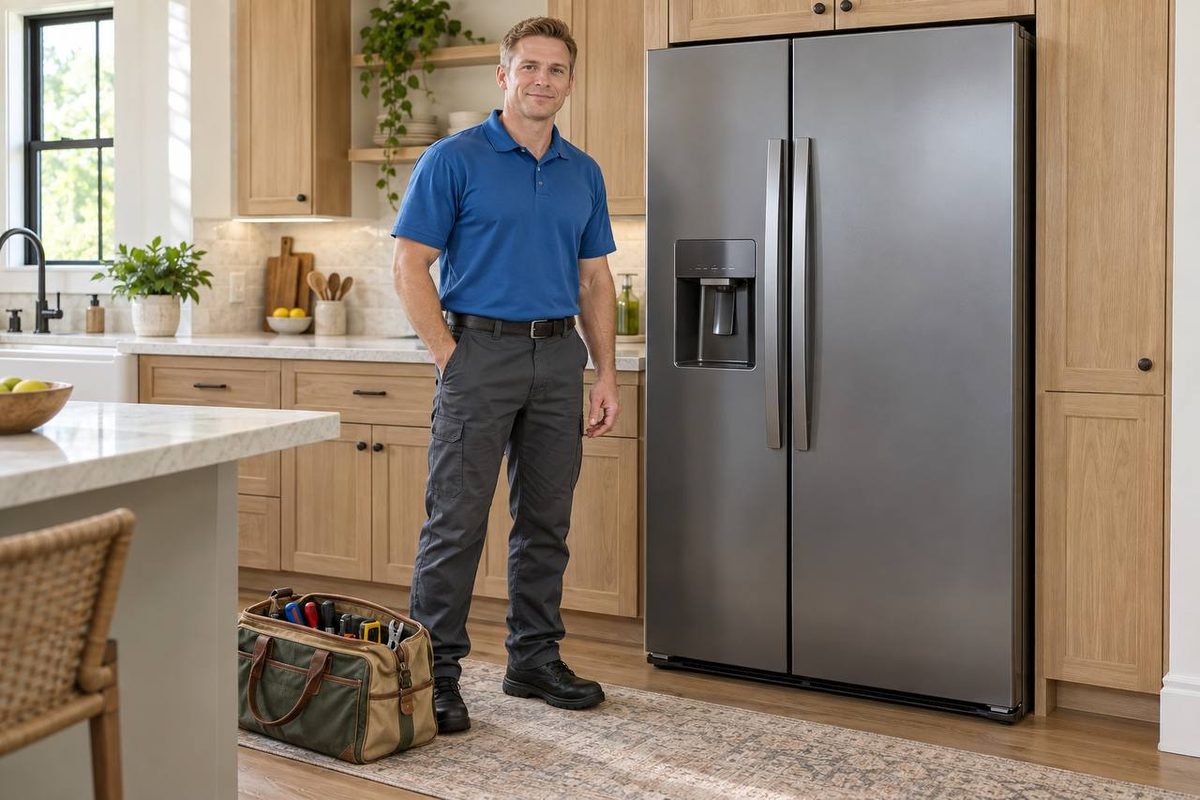
How an Olympia refrigerator visit runs
You get an arrival window when you book, and a warming refrigerator moves up the list. On arrival our technician records both compartment temperatures, pulls the unit out when needed and tests rather than guesses: fan motors, defrost components, start relay, thermistors and the control. Then you receive one written quote, fixed before any work starts. The visit itself is $97. If you approve the repair, that $97 counts toward it in full rather than sitting on top as an extra; if you decide against it, the $97 covers the diagnosis and nothing else is owed. Many common parts travel with us. If yours needs ordering, we go over ways to keep the food safe in the meantime and return to fit the part without billing another trip.
Repair or replace a refrigerator in Olympia
Most refrigerator failures we find in Olympia are fan motors, defrost parts, start relays, seals and water valves, and those are usually worth repairing on a cabinet that is still sound. The decision gets harder with a sealed-system fault, such as a refrigerant leak or a compressor that will not run, on a unit well into its second decade. In that case we explain what the sealed-system work involves and how the rest of the refrigerator looks, then let you weigh it without pressure. Should the manufacturer’s coverage still apply, that comes up at the start of our conversation, since a claim through the maker may serve you better.
Care tip: Every six months, with the cord unplugged or the circuit off, vacuum the condenser coils under the front grille or on the rear panel. In Olympia’s damp air, dust on those coils turns into a sticky mat that makes the compressor run longer and hotter. A coil brush and ten minutes keep it clear.
More repairs in Olympia
Same repair nearby
Repair guides
Book a repair in Olympia
One fixed quote after diagnosis. $97 diagnostic, applied to the repair if you go ahead.