Why Lacey dryers slow down, and what we check first
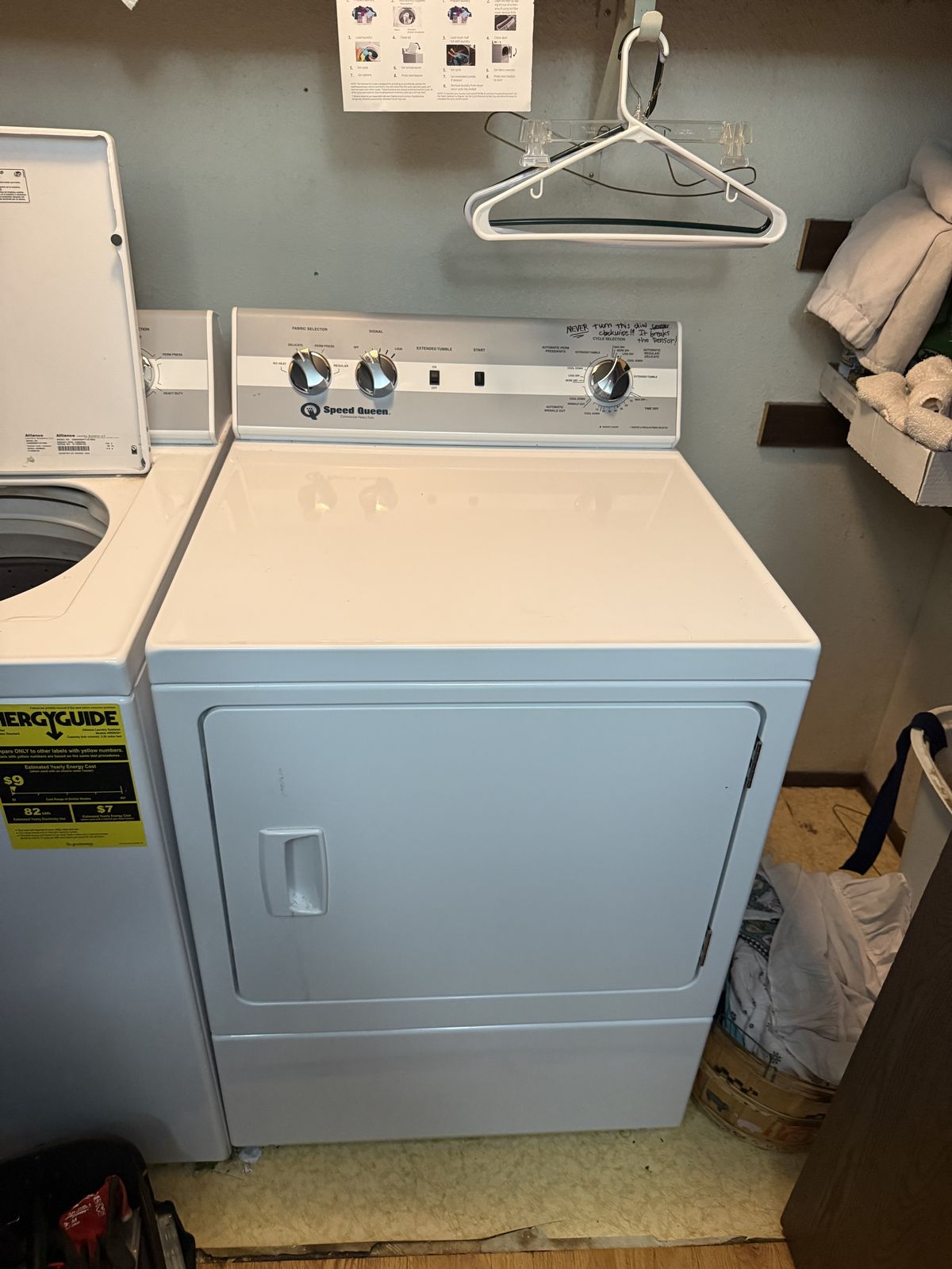
A dryer that takes two cycles in Lacey is rarely just a bad heating element. Many homes here are two-story houses built since the 1990s, with the laundry upstairs and an exhaust duct that winds through a wall or attic to a hood on the roof or siding. Every elbow and every foot of that run cuts airflow, and the dryer pays for it in slow loads, tripped safeties and lint packed where it does not belong. Townhomes put the dryer in a closet stacked over a washer. Older 1960s houses sometimes run ducts through crawlspaces where damp air condenses. Natural gas fuels the furnace in a sizable slice of Lacey, Olympia and Tumwater homes (roughly 35 to 44 percent), so a gas dryer on the laundry hookup is no surprise; our team works on gas and electric dryers alike, plus propane units at the rural edge.
We measure before we replace. Our technician reads exhaust airflow twice, once behind the machine and once where the vent leaves the house, and then works through the heat circuit with a meter, part by part. For an electric model the order runs heating element, cycling thermostat, high-limit thermostat and thermal fuse; for gas, it covers the coils on the valve, flame sensor and igniter, and ends with us watching a burner cycle light. Noise calls get a look at the drum rollers, idler pulley, belt and blower wheel. Moisture sensor bars, door switches and timers or control boards round out the list. Speed Queen, Whirlpool, Maytag, Kenmore, GE, LG, Samsung and Electrolux dryers are all familiar to us. A blown thermal fuse is never jumpered just to get the drum turning; we track down the restriction that tripped it before a replacement fuse goes in.
Lacey rain, fog and power, seen from the dryer
Water reaches a dryer through the air, not the pipes. The South Sound sees about 50 inches of rain on roughly 160 days, November is the wettest month, and humidity sits near 80 percent, so loads start out heavier and ducts carry more moisture. In ducts that cross a crawlspace or unheated garage, warm exhaust condenses and turns lint into paste. Moss and fir needles jam outside hood flaps open or shut. Power matters too: PSE windstorm outages and surges can scramble electronic controls, and an electric dryer that loses half of its 240-volt supply will tumble with no heat. Many Lacey dryers burn natural gas, while propane serves rural edges. A gas smell means everyone goes outdoors first, and the call to the utility is made from there.
Dryer patterns in four Lacey neighborhoods
- Hawks Prairie. Two-story homes in these master-planned subdivisions often put the laundry upstairs and send exhaust through a long duct to a roof or side-wall hood. That length plus a few elbows is enough to stretch a cycle and trip the high-limit thermostat. We measure airflow at both ends and tell you whether the dryer or the duct is at fault.
- Meridian Campus. These townhomes lean on stacked laundry centers tucked into closets, and a shut closet door holds heat around the dryer. A crushed foil transition duct behind the unit is a frequent find. We check the duct, the cabinet clearances and the blower wheel, and we service the upper dryer without hauling the pair out whenever the layout allows.
- Woodland Creek area. Where homes in the Woodland Creek area sit under trees, fir needles and moss collect where dryer hoods are mounted. A flap stuck half-closed slows every load, and one stuck open lets damp air and birds in. We check the hood while the dryer runs, clear what we can safely reach and note when the duct needs attention.
- Tanglewilde. When a 1960s house in Tanglewilde runs its dryer duct through the crawlspace, cold, damp air there condenses the exhaust and lint settles in low spots. Gas dryers are common in these homes too. We look for sagging or crushed duct sections, test the thermostats and fuse that poor airflow wears out, and leak-check any gas fitting we touch.
Where our crew works
We cover all of Lacey, from Hawks Prairie, Horizon Pointe, Meridian Campus, Jubilee to the streets between. Tap a town on the map for its page.
Dryer symptoms Lacey households call about
- Upstairs loads take two cycles. When towels come out damp after a full timed cycle in a second-floor laundry, airflow is the first suspect. We read exhaust flow at the dryer and the outside hood, check the transition duct and blower wheel, then meter the heat circuit. A long Lacey vent run often explains the problem before any part does.
- Heat quits on a long vent run. A dryer that heats for a while and then stops for good has often blown its thermal fuse, usually because exhaust could not escape fast enough. Replacing the fuse alone just sets up the next failure. We test the fuse and high-limit thermostat, measure airflow, and clear the restriction so the new fuse lasts.
- Gas dryer glows but won't light. When the igniter turns orange, fades, and no flame follows, the gas valve coils or flame sensor are the usual causes; if it never glows at all, the igniter or a thermal fuse is. Each of those gets a meter reading, and we watch a full ignition cycle. Every gas-side repair ends with a leak check at each fitting.
- Squeal from the stacked closet dryer. A squeal that starts a few minutes into each load often comes from a dry idler pulley bearing, while a rhythmic thump points to drum rollers or a flat spot on the belt. In a Lacey townhome closet the noise carries through shared walls. We replace the worn part and check the others while the drum is open.
- Sensor cycle stops, clothes still damp. Sensor-dry cycles judge dryness through a pair of metal strips that wet clothes brush against as they tumble. Softener and dryer-sheet residue coats those strips, so the control decides the clothes are dry when they are not. In Lacey's humid months the shortfall is easy to notice. We clean and test the sensor bars and the control that reads them, and check airflow while we are there.

A dryer visit in Lacey, step by step
When you call, tell us the fuel (gas, propane or electric), where the dryer sits, and whether the vent exits a wall or the roof. Same-day service is possible on days the route has space. Our technician checks airflow first, then tests the heat circuit, drive parts and controls, and shows you what the readings mean. The visit carries a $97 diagnostic charge. If you approve the repair, that full $97 rolls into its cost; if you stop at the diagnosis, the $97 is all you pay. Your quote is fixed and written before any part changes. We usually carry fuses, thermostats, igniters, elements, belts and rollers. Anything we have to order, we bring back and install without charging for the second drive out.
Repair or replace a dryer in Lacey
Dryers are simple machines, and most failures here come down to modest parts: fuses, thermostats, igniters, elements, rollers, belts and sensors. Those repairs usually make sense even on an older dryer, as long as the drum, bearings and cabinet are sound. Replacement looks better when a rusted drum snags clothes, a rear bearing has worn the drum support, or an aging control board has been discontinued. If the dryer is young enough that its maker's warranty still applies, that comes up first. Either way, we write up both options, including whether the vent run needs work, so a new dryer does not inherit the old problem.
Care tip: After each load, peel the lint from the screen, and if you use dryer sheets, scrub the screen with dish soap every couple of months. Once a season, start the dryer and step outside to confirm the hood flap opens fully. Around Lacey homes, moss and fir needles are the usual reason it does not.
More repairs in Lacey
Same repair nearby
Repair guides
Book a repair in Lacey
One fixed quote after diagnosis. $97 diagnostic, applied to the repair if you go ahead.